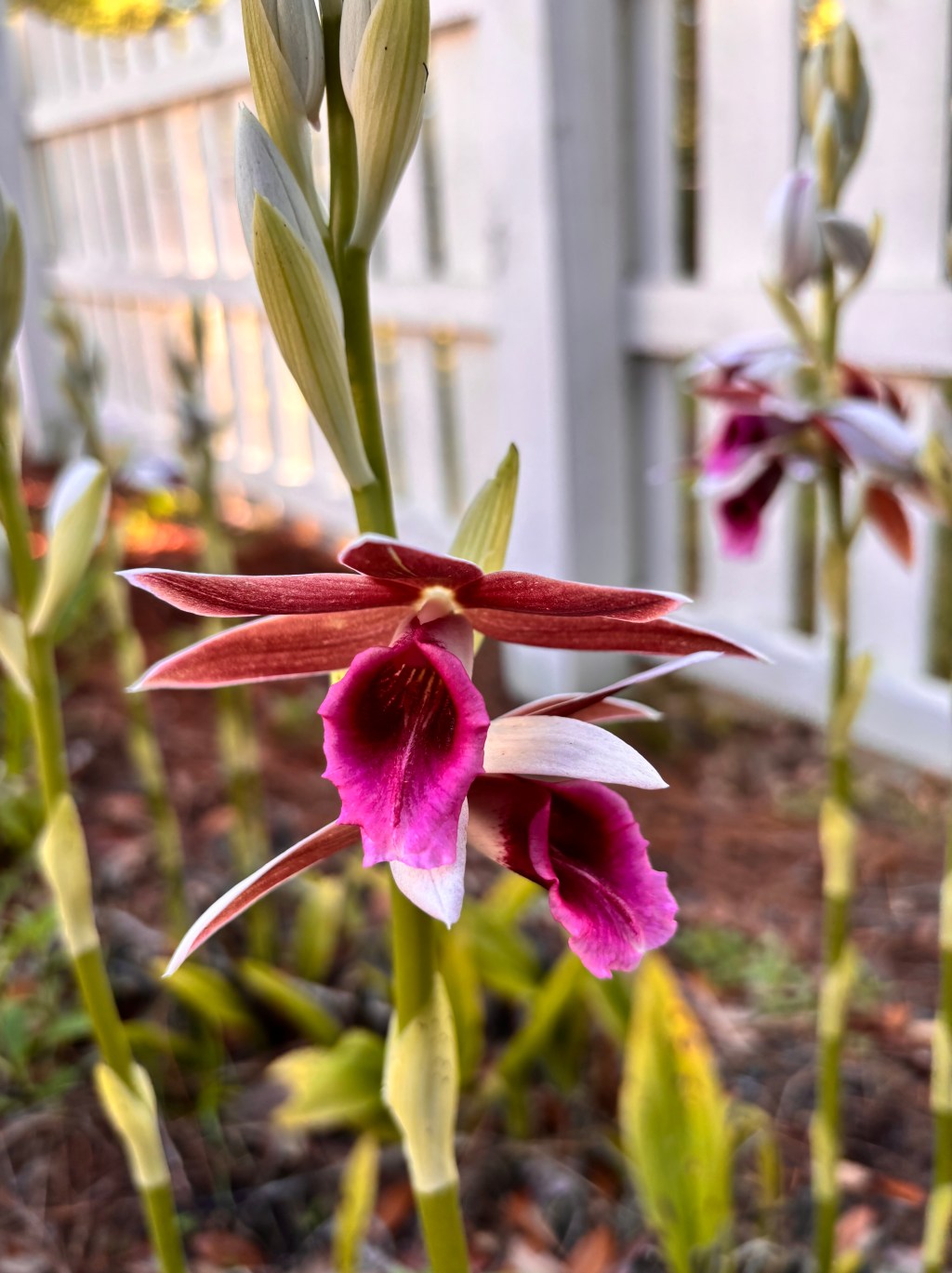
Several years ago, a friend of mine with a connection to a local nursery gave me a plant that was being discarded because it was “a bit off”. She told me this particular plant was called a “Nun’s Hood Orchid” (Phaius Tankervilleae in gardener-speak) because its flowers resemble a nun’s wimple, which for decades was a signature feature of a nun’s daily dress or “habit” (think Sally Field in “The Flying Nun” or the sisters in “Call the Midwife”).
My prior experiences trying to keep orchids alive as indoor plants had been disastrous, so I was pretty intimidated by the challenge of trying to grow an already struggling orchid outside. But I was so intrigued by its name, I had to at least give it a chance. I found a sunny spot in my backyard, dug a hole and put the mystery plant in the dirt.
That was my first sin. I should have planted the near-dead orchid in a container that I could bring indoors when the outdoor temperatures dropped below 35 degrees. But I assumed (without researching) that because the plant’s bulbs were deep in the ground, if I covered it with a sheet on cold nights, it would be fine.
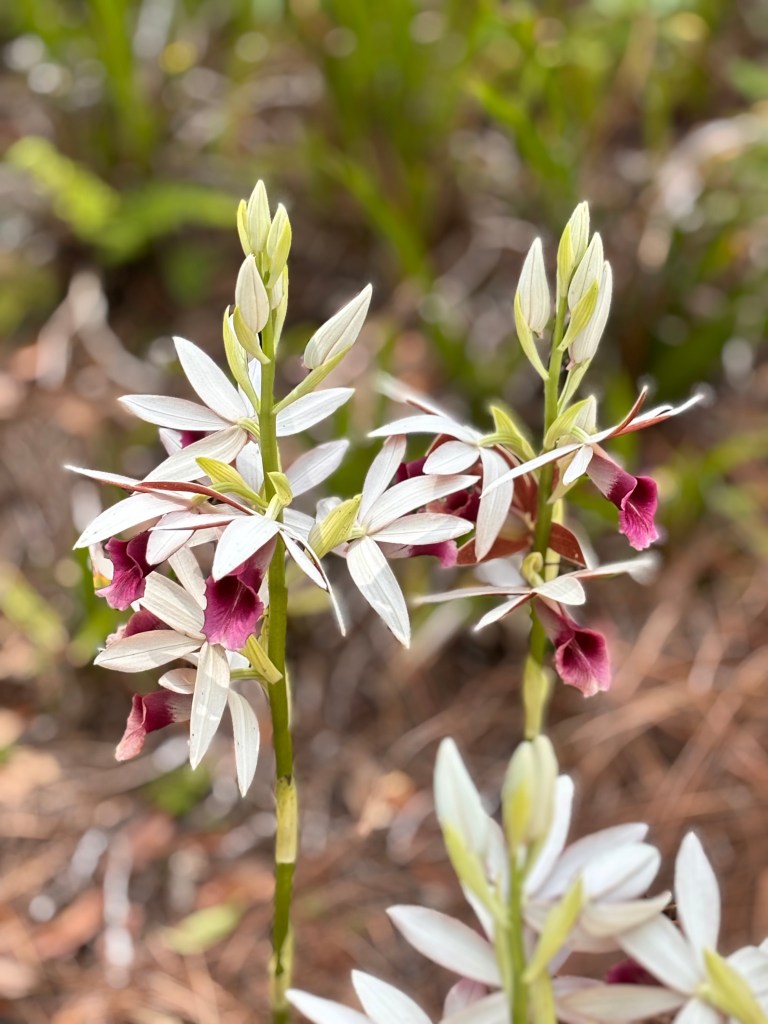
Well, this poor plant that started out so humbly and didn’t receive any special attention (or fertilizer) managed to persevere through the winter and the following spring, it came back to life and produced the most remarkable and unique flowers. And they really did look like a nun’s wimple!
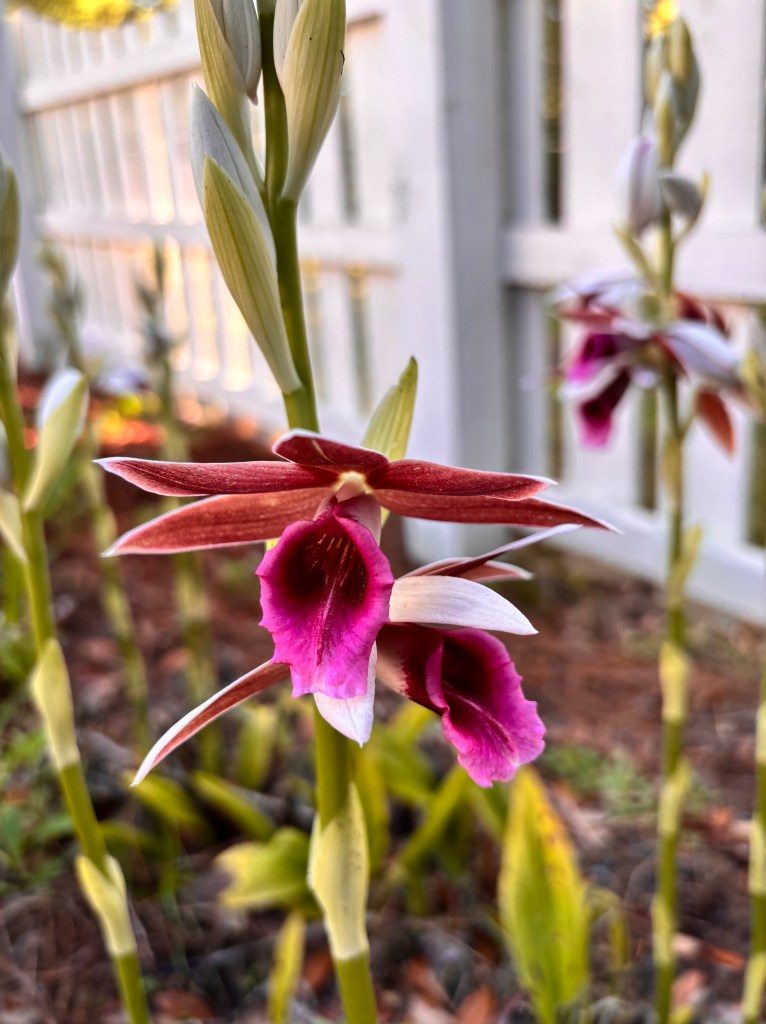
Since that first miracle spring, the orchids have endured many more cold winters – even the freak snow we had in Tallahassee this past January. The cold weather turns their leaves black every year (just like a nun’s habit!) – but miraculously, as soon as the weather starts to warm up again, their bright green stalks start pushing up through the dirt in preparation for the flowery display. The original bulbs I planted have multiplied generously over the years, but the flowery stalks have stayed clustered closely together.

It’s interesting that the central blooms of these orchids don’t point toward the sun. In fact, they nestle under their signature “hoods” that seem to act like a protective shade canopy. You have to stoop down to get a clear glimpse of the most beautiful part of the flower underneath those hoods. It’s as if they don’t want to be too showy – maybe it wasn’t just the wimple that inspired their nun-associated moniker?
My father’s youngest sister is a Catholic nun. She made the decision to enter the convent in 1948 when she was 14 years old. Growing up with an aunt (Sister Marie Jeannette – or Aunt Marie, to us) who was a nun wasn’t that strange to me. I attended a Catholic grammar school, a Catholic high school – even a Catholic university for college. Nuns played a key role in my academic education and my social and moral upbringing.
But my Aunt Marie – and nuns in general – were always a mystery to me. When I was going to school, nuns still wore habits and veils that set them apart from the lay teachers. I don’t even think they were allowed to hang out in the teacher’s lounge. They lived together in a convent, which was mostly off-limits to others.

Growing up, we would only see my aunt a few times a year for holidays and other family-get togethers. She would wear her habit at those affairs, until the church relaxed the requirement. But even after she was allowed to wear “real clothes”, she stuck with a simple and sensible wardrobe, in keeping with her vows. When she officially entered the sisterhood, she took vows of poverty, chastity and obedience to the Catholic Church for the rest of her life.

After my father died in October 2021, I started thinking more about my Aunt Marie – by then, his only surviving sibling – and I realized just how little I understood about her. I knew she had lived all her life in a convent, she was a dedicated educator, a former school principal and had served in high level positions within the School Sisters of Notre Dame (the Order she joined when she became a nun). I remember asking her once what she planned to do when she retired. She laughed and explained that being a nun wasn’t a profession – it was a calling. She had given her life to the church and there was no retiring from that. Ever. Wow.
Still, I didn’t know much about her as a person – much less, a woman. For me, she had always lived behind a literal and figurative veil, and I was either too afraid or too embarrassed to ask personal questions and try to get to know her.
But I knew she had a story to tell. She was 87 years old at the time and if I wanted to get to know her, I couldn’t wait much longer.
Then I heard that the National Public Radio StoryCorps project was coming to Tallahassee – and they were recording interviews remotely as an accommodation for the pandemic. So I reached out to the StoryCorps folks and they were excited about the idea of an interview with a nun (they told me they hadn’t done that yet). When I reached out to my aunt at her convent in Connecticut, she didn’t even know what StoryCorps was, but she was willing to give it a try.
I had to go up the chain with the administrative officials at her convent in Connecticut and the public relations people with Diocese of Baltimore to get permission to do the interview, but my Aunt Marie and I finally went live on December 17, 2021.
I am so proud of her courage and her willingness to come out from under her veil and share some of her story. The interview can be found on the StoryCorps website and on the website for the School Sisters of Notre Dame.
We got off to an awkward start (I think we were both nervous – and she was unaccustomed to talking about herself), but pieces of her story slowly emerged (I was shocked to learn she first realized she wanted to join the sisterhood at age 6) and I was able to imagine her as a little girl, a teenager and a young adult with an uncommon faith and sense of purpose that has guided her throughout her life.
The irregular Nun’s Hood Orchid I planted against the odds in my backyard had a story to tell about tenacity, humility and beauty. The conversation with my Aunt Marie taught me how important it is to take the time to learn the stories of the people in our lives. To give them a chance to write their narratives for us – instead of forming our own (and often, incorrect) assumptions about the paths they have taken with their lives and the things they hold dear.
“Fools find no pleasure in understanding but delight in airing their own opinions.”
Proverbs 18:2
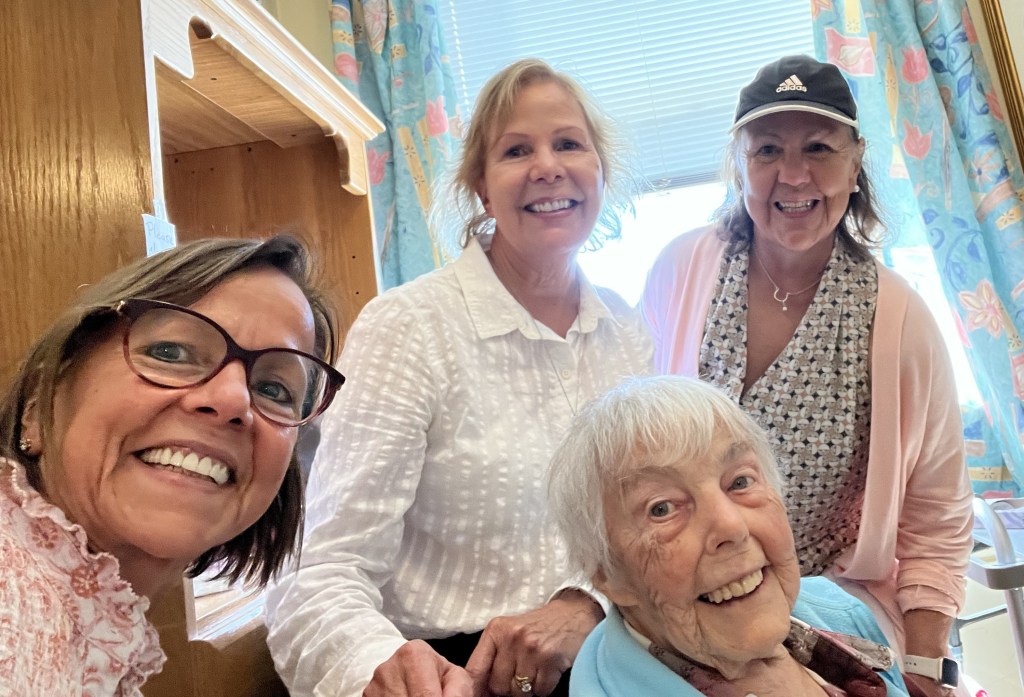
P.S. My Aunt Marie is now 91 years old and lives in a nursing home with other aging nuns in Queens, New York.


 Glean Daily
Leave a reply to Out of Season – Glean daily Cancel reply