Last Saturday, I was riding my bike with some friends in a rural area outside Tallahassee when we spotted a group of people in the distance along the grass shoulder of the road.
As we got closer, I could see they were wearing reflective safety vests and carrying trash bags, so I assumed it was a work crew performing mandatory community service for some criminal offense. But there was no official van or corrections officer in sight.
When we finally passed them, I realized it was just an informal group of women and men and young girls and boys picking up trash as they worked their way down the road. They were chatting and seemed to be enjoying their efforts. It was such an unexpected and encouraging sight, I thought about them for the rest of the ride. I wondered why they were there, on a beautiful Saturday morning, generously volunteering to clean up a mess someone else had made.
Last year, my friend Su Ecenia returned from a bike ride in that same area, outraged at the amount of trash she saw in the culverts of another nearby road. She recruited me and two other friends to spend a morning picking up discarded beer cans, liquor bottles, snack bags, plastic cups and other random items littering the culverts.
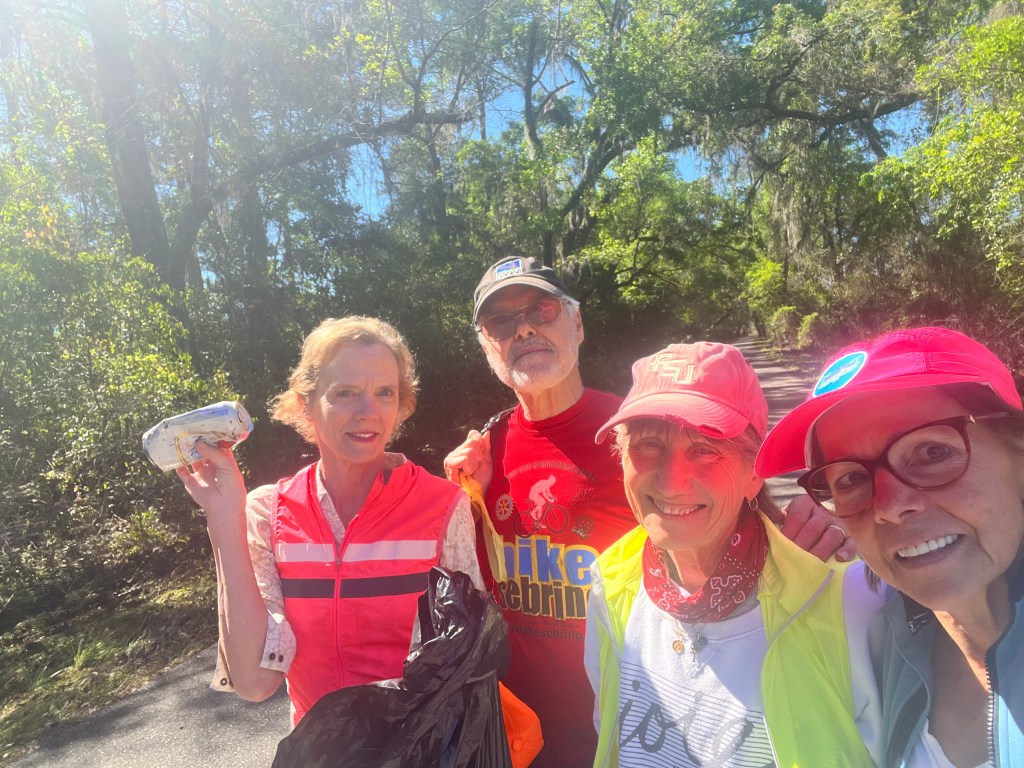
We worked for hours – and filled lots of trash bags. But when we rode past the scene of our efforts a few weeks later, there was a whole new supply of cans, bottles and miscellaneous junk strewn across the culverts. I’m guessing people have been tossing beer cans and bottles into the culverts of that rural road for decades. And dumping tends to beget more dumping. If a place is chronically littered with garbage, it gives the impression that no one cares about it, lowering the threshold of guilt another person might feel about adding their trash to the pile.
Roadside trash isn’t anything new. The Keep America Beautiful organization has been trying to clean up our roadways and prevent littering since the early 1950’s. Their efforts have made huge impacts all over the country, but roadside trash is not a static phenomenon, and it remains a problem.
While I can honestly say I am not a contributor to the roadside trash problem, there’s another, equally insidious type of trashiness I participate in more often than I’d like to admit. I’m talking about rhetorical trash. Trash talking.
I frequently catch myself participating in conversations about politics, social issues or current events where the tone is vigorously negative – and there is no constructive goal. In the moment, it can feel satisfying – especially if the people I am talking with share my perspective. It’s a chance to expel some of the confusion and frustration I experience when I try to make sense of the information dominating news cycles and social media. But those conversations don’t solve anything, and they are the rhetorical equivalent of roadside trash. They clog up the flow of original thought – like the bottles and cans in the culvert that prevent rainwater from flowing down to nourish nearby plants and grass. Those negative conversations suppress the consideration of alternative ideas and distract us from deepening our understanding of one another as individuals.
I don’t want to be a verbal trash flinger. I don’t want to become so inured to negative rhetoric that I don’t even notice it anymore and feel no guilt adding to the existing heap.
I want to remember that group of people on the side of the road last Saturday. The volunteers who set out to make a positive impact – quietly and without any recognition. They didn’t create the trash problem on that road, and their efforts that day didn’t result in a complete or permanent solution. They banded together around a shared commitment to restore the natural beauty of a section of country road and undo the damage caused by someone else’s carelessness. And in doing so, they tipped the scales of their community back in the direction of beautiful.
Those weren’t convicts out on the shoulder of that road, but they certainly convicted me. You just never know what impact your actions can have on an imperfect stranger.
“Do not let any unwholesome talk come out of your mouths, but only what is helpful for building others up according to their needs, that it may benefit those who listen.” (Ephesians 4:29


 Glean Daily
Leave a reply to Bonnie Wright Cancel reply