As promised the night before, our guide Uriel came knocking on the doors of our glass-paneled igloos at 4:30 am with a steaming cup of Coca tea to wake us up for the day’s 14.6 mile mountain trek and climb to Salkantay Pass. I was told the Coca tea would help with the altitude (we would be hiking from 12,795 ft. to 15,190 ft. of elevation before lunch), so I happily drank it, but honestly can’t say whether it had any positive effect.
When we gathered in the modest dining hall for our pre-hike breakfast, there were climbing groups from all over the world sitting at the tables, speaking a variety of languages. I didn’t need to understand their words to know what they were saying. Nervous excitement about the challenge we were all about to undertake became a common language with its own vocabulary. We may have been strangers in life, but that morning, we were colleagues in a shared adventure to a place we had never been and an elevation few of us had ever reached.

We ate breakfast strategically, mindful of the energy we would need over the next 12 hours – but careful not to get too full. We packed as much water as we could carry in our daypacks and headed to the start of the trail.

The four-hour climb to Salkantay Pass lived up to its reputation as the most challenging section of the Trek to Machu Picchu. Our forward progress was steady and difficult, and each time I looked into the distance at the line of hikers ahead of us, I was shocked by how much more trail we still had to cover before we reached the Pass.

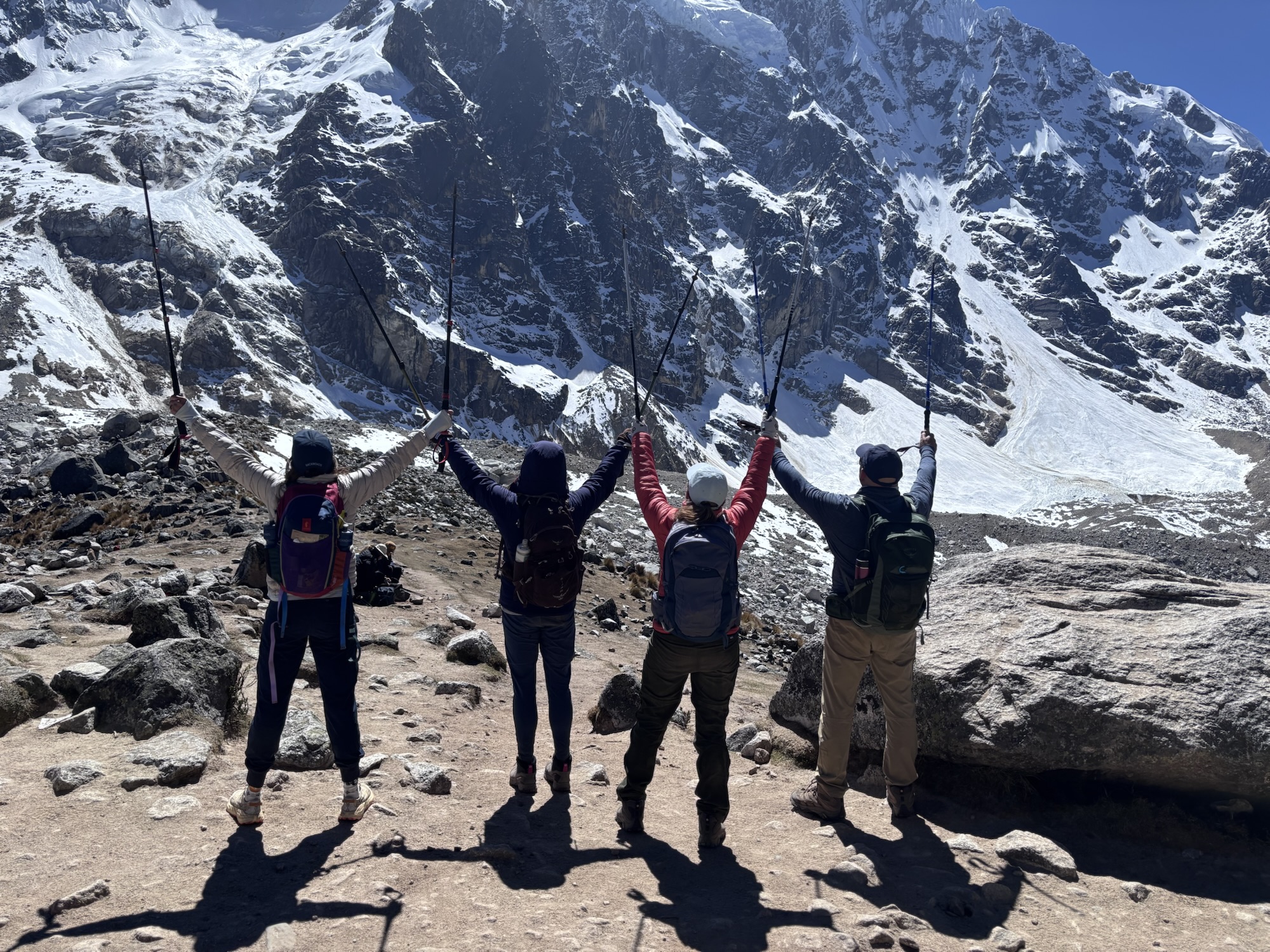
When we finally reached Salkantay Pass, I was overcome with a rush of relief, elation, exhaustion and awe. The view was breathtaking and intimidating. Towering over us at 20,574 feet was the massive Salkantay Mountain, whose cover of snow and ice sparkled in the sunshine. The name Salkantay comes from the Quechua word “Salqa” which means “invincible” or “savage”. Uriel told us many hikers have lost their lives attempting to reach its summit.

As more climbers arrived at the Pass, they sprawled out across the rocks, laughing and celebrating. The atmosphere was electric – probably fueled by a mix of the thin air at 15,000 feet, physical and mental fatigue from the climb and excitement that the hardest part of the day was behind us. But it was only 10:30 in the morning, and we still had another 16.5 k (roughly 10 miles) to go before we reached Mountain Sky View – our destination for the evening – so we left our rock tributes to the mountain and continued our trek.


A funny thing happened along the rocky, 10-ish mile route to Mountain Sky View. I noticed that after we reached Salkantay Pass, something in the atmosphere changed (not the oxygen level, but the vibe). Leading up to the Pass, the other hiking groups were polite, but pretty self-contained. Now that we had all conquered “the savage” together, we became a little community. Not a community defined by where we lived, the languages we spoke or our ethnic or national identities. It was more like an accidental fellowship of determined, dusty, unbathed hikers united by our shared experiences of uncertainty, pain, fatigue – and ultimately, the joy of overcoming a daunting challenge. Those gritty factors transcended the typical social, cultural or generational distinctions that might have otherwise divided us – and made our journey even more memorable. The young hikers who had previously ignored me started to engage. We all laughed more and looked out for one another when the trail got rough.

I didn’t need to travel to Peru to learn that community is important. But I am thankful for the reminder that humans are meant to live in community. As Mother Theresa once said, “Today, if we have no peace, it is because we have forgotten that we belong to one another”.

“Live in harmony with one another.
Do not be proud, but be willing to associate with people of low position.
Do not be conceited.”
Romans 12:16

Leave a Reply