I know plants don’t have brains, but sometimes I wonder…
I tried again this year to grow a row of sunflowers along the eastern section of our backyard fence. I purposedly planted more than one type of seed, hoping for a dazzling and diverse display of tall, yellow-petaled sun-lovers.
The first leafy stalk to escape the appetite of the ^$@^#* rabbit who thinks every green plant I try to grow should be his supper looked to be a winner. Its stem was straight and strong and it quickly grew past the height of the fence in search of the morning sun.
When it finally bloomed, the flower was magnificent. Bees, butterflies – even ladybugs – were attracted to the bright yellow center, where they feasted on its nectar and did their part to perpetuate the cycle of pollination and fertilization.

A bee and a ladybug enjoy my mammoth sunflower.
In stark contrast – and just a few feet away – another sunflower began to grow upward, but then it stopped at about the midpoint of the fence. Given its shorter height, that less-advantaged sunflower would miss out on at least four hours of morning sunshine. When it finally started to form a flower bud, I was not optimistic about its potential to blossom.
But what did I know?
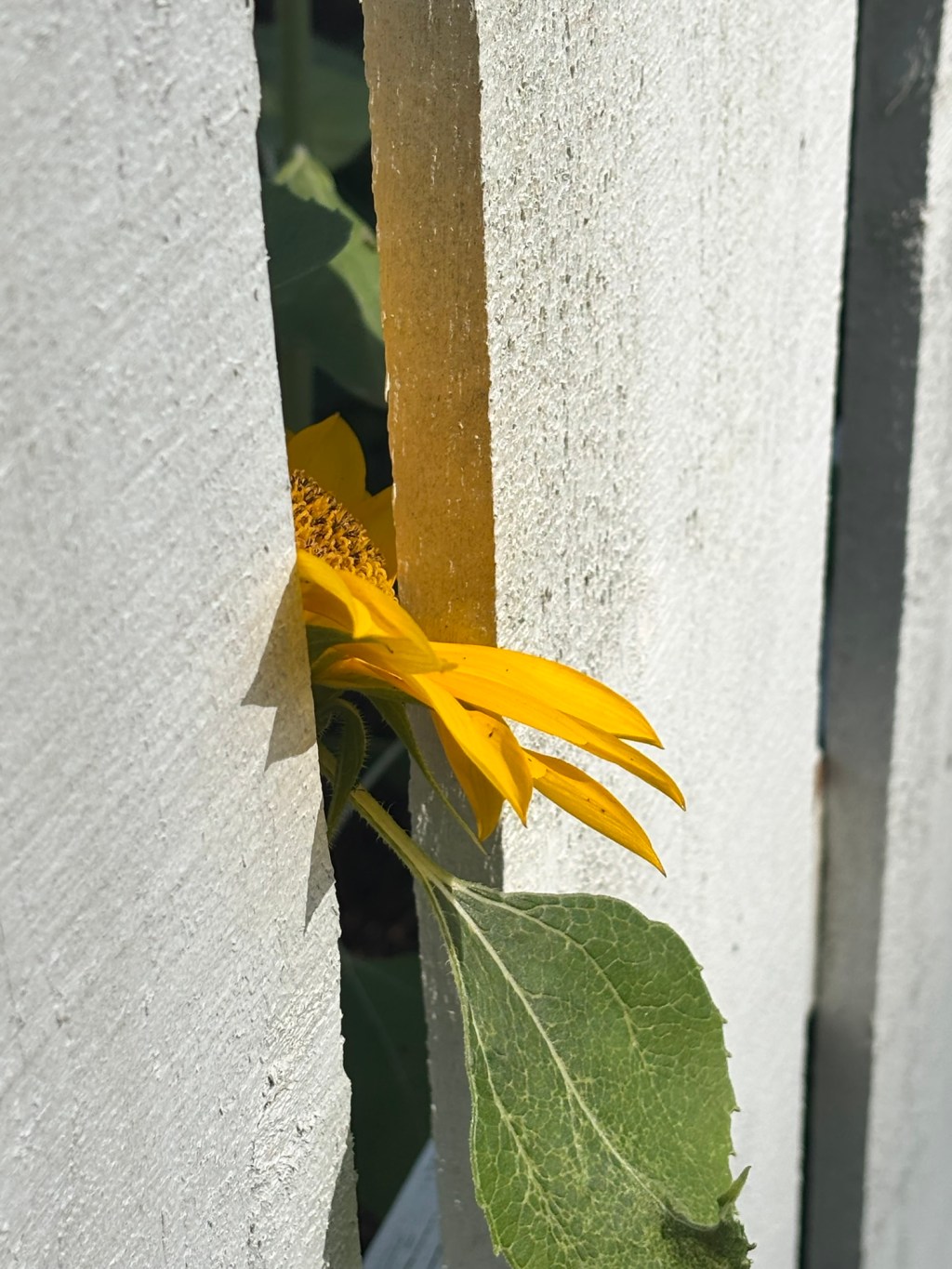
On my way to feed our chickens one morning, I noticed the growth trajectory of my little half-height sunflower had taken a decidedly horizonal turn. Somehow, that determined plant sensed that if it stretched its stem toward the little gap between the fence slats, it could poke its head through to capture the morning sun just like its mammoth cousin. I was blown away.
I know plants don’t have brains, but sometimes I wonder…

In my blog post, In Search of the Sun, I wrote about the phenomenon of “plant tropism”, which is the response by plants to stimuli. There are different types of plant tropism. Sunflowers are famous for displaying “heliotropism” or “solar tracking” – which is when a plant follows the path of the sun during the day.
I still have trouble comprehending how something without a brain can know how to alter its movement and growth patterns to get more access to the sun, but that is what happened with my sunflower. My backyard fence wasn’t a barrier; it was an opportunity to display agility and creativity.
It was a timely lesson for me.
We received some difficult news last month that has left me feeling like I’m stuck behind a tall and solid fence of uncertainty.
That little sunflower, angling itself to fit between two fence slats was a God-sent kick-in-the-butt reminder to me to trust that the sun will still come up every morning, whether I can see it or not – even if I’m too busy to notice. Difficult times are inevitable – but not insurmountable. Focusing on the fence as an obstacle will keep me in the dark, and prevent me from remembering the many difficult experiences I have already come through and the positive growth that has resulted from them.
But if I keep my heart and mind open, I can catch small glimpses of the other side of the fence that give me hope – like an unexpected act of kindness from a stranger, a timely word of encouragement from a friend, or a little sunflower that shows me how to grow through an obstacle to find the sun.

Consider it pure joy, my brothers and sisters,
whenever you face trials of many kinds,
because you know that the testing of your faith produces perseverance.
Let perseverance finish its work so that you may be mature and complete,
not lacking anything.
James 1:2-4


 Glean Daily
Please share your own gleanings!